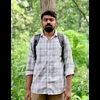
Back on August 13, I was taking temperature readings inside a granite crevice at Gardumma in India’s Jharkhand state. It had rained a little earlier and the sky was mostly cloudy. The air temperature was around 32°C. When I pointed my IR temperature reader at the rock surface just inside the crevice, it read 46°C, but the air temperature inside the crevice was a much cooler 33.7ºC.
The heat inside that crevice felt different. The air was humid and heavy. Sweat stayed on my skin. The smell of wet soil and granite was strong after the rain. Mosquitoes kept buzzing around my face and biting me while I was trying to take readings. This is what a lot of my fieldwork looks like. I start early, usually around 7 a.m., and spend hours moving across boulders, rocky slopes and granite outcrops. Sometimes I am measuring temperatures. Sometimes I am looking into a crevice, a moist pocket or a shaded corner to see whether any animals or insects are using it.

Measuring the temperature of a crevice
If the rock around me can become this hot, where does an animal go for refuge when the surrounding landscape becomes too hot?
The granite hills of Santhal Pargana rise abruptly from the surrounding plain. One of the tors I work on rises approximately 180 meters above the surrounding plain, based on drone measurements. From a distance, these hills look dry and exposed, with fields and palms around them and scattered boulders breaking up the landscape. But once you start walking across them, the surface becomes much more complicated.
There are cracks running between granite blocks, shaded edges beneath boulders, pockets where moisture remains after rain, and deeper crevices where an animal can disappear completely. A rock that looks uniformly hot from a distance can contain several very different microhabitats within a few meters.

Drone view of Thengimo Hills
That’s what sparked my interest in thermal refugia, spaces in the natural environment that can protect animals from the extreme heat of hot rock surfaces, and from direct sun. I wanted to understand whether these spaces were simply features of the rock or they were being used by wildlife as shelter from exposure and the heat outside.
I have grown up here. The Santhal and Paharia communities have been my neighbors, and I have seen these hills not only as forests and wildlife habitat but as places where people live, farm, collect food and follow their traditions. I am not Adivasi, a term for India’s tribal and Indigenous communities, but I grew up in this landscape and have now returned to it with a researcher's questions about the environment.

Drone view of a ridge system
Take the Manjhi Than, for example. In a village, this sacred structure can be a simple concrete platform with a thick sal tree (Shorea robusta) branch or post fixed into the ground. It is an important community space where village festivals and other important occasions begin. Manjhi Haram is the village head who leads the rituals there. For someone unfamiliar with the region, the Manjhi Than may look like an ordinary structure. For the people of the village, it is the social and cultural center of the community.
Marang Buru puja, a form of worship honoring the Indigenous creator deity, is also part of the cultural life of these communities and their relationship with the surrounding landscape. The festival of Jantar is observed a day before dhan ropni, the planting of rice. It is associated with hopes for a good harvest and with the protection of the surrounding biodiversity and well-being of the community.
There is also a tree that Santhal people call soso — the bhelwa (Semecarpus anacardium).
We use this tree during a ritual called Della, which is performed before the paddy harvest. A branch of the tree is cut and brought to the courtyard where the harvested paddy will be kept. The courtyard is first plastered properly with cow dung, and the branch is then planted in the center. When we bring the paddy from the fields, we believe this tree protects it from buri nazar, or the evil eye. It also helps protect the stored paddy from insects and other damage and helps us keep it safely for a long time. For us, this tree is like a rakshak —a protector of our paddy. (Translated from Santhali)
—Kunwar Hembrom, 65, Santhal community member
Some of my wildlife observations have changed the way I look at the granite cracks. Indian jackals (Canis aureus indicus) have been particularly interesting. During one observation near a road corridor, I saw an emaciated jackal who looked weak and sluggish and showed very little flight response. Seeing an animal in that condition made me think about how much pressure wildlife is already facing outside the refugia. If an animal is already moving through a landscape where food, water and safe shelter are becoming harder to find, then a protected space inside a granite outcrop may mean more than simply a place to rest.
On another night survey, I found a jackal sitting inside a granite refugium. I could not know simply by observing why it was there. It may have been resting, avoiding disturbance or using the space for shelter. But the observation stayed with me because it made the connection between the animal and the rock much more tangible. Instead of only asking whether these cracks are cooler or more protected, I started asking whether wildlife actually depends on them.
I have also observed reptiles and other animals using rocky microhabitats, while Indian jackals and striped hyenas (Hyaena hyaena) are among the wildlife associated with this wider landscape. What interests me is not just the presence of an animal inside a crack, but what that behavior might tell us about how wildlife is responding to a changing environment.
Rahul Kumar Das, one of my field assistants, is noticing a change too:
Earlier, whenever we saw a siyar, or golden jackal, we were afraid that it might attack us. Now, when the siyar sees us, it runs away with its tail between its legs.
Working outside protected areas in Jharkhand is difficult. We have to work around the heat coming off exposed rock, and sometimes we have to put our hands into large cracks in the granite without knowing what may be inside. (Translated from Hindi)
Another field assistant, Alok Kumar Manjhi, describes it differently:
In landscapes like Thengimo Hills, Markanda and Rajapathar-Boriya, we used to see animals here. But now roads have developed and human settlements have spread. What do you see on the hills now? Goats climbing the rocks. Where are the hyenas and jackals?
In these hills, goats, their young and cattle now move across the rocky slopes. In the last one to two years, we have not come across any recent incidents of hyenas or jackals attacking goats or causing damage in the surrounding villages. They still move around village edges but, when they get the opportunity, what we see is mostly smaller opportunistic behavior — taking chickens or food from around houses. (Translated from Hindi)

Community discussion
Fire is one of the clearest changes I notice, especially during the colder months. In the villages around these hills, people sometimes set fire to the forest and scrub to clear the dense undergrowth so they can move through the forest more freely, cut and burn invasive plants, and make the areas on lower slopes near the fields easier to use for agriculture. During my fieldwork, I have photographed and recorded many of these fires. For the villagers, it can seem like a practical way of managing the landscape. But once the fire passes through, the vegetation around the rocks changes. The shrubs and ground cover disappear, the dry vegetation is burnt and the small sheltered spaces that wildlife uses are left in a different condition.
Free-ranging dogs move through the landscape. Invasive lantana shrubs are present and the roads cut through the wildlife routes — the amount of roadkill shows what can happen when animals are forced to cross them.
These various pressures are connected. An animal looking for food may have to move farther afield. An animal looking for water may leave its usual area. An animal looking for shelter may find that a familiar patch of vegetation has been burned. A road then becomes part of their journey.
Hunting is another part of the story, but I do not want to turn this into a simple argument about local people causing wildlife decline. That would leave out too much of what I see. The people living here depend on the same forests, fields and hills as the nonhuman animals do, and they are also living through the same changes. Some places are heavily used by people, while others retain cultural importance and are treated differently.
Wildlife and people are moving through the same landscape.
Within that shared landscape are the granite refugia.
That 46°C reading from the rock surface at Gardumma on August 13 is only one measurement. I need more observations across seasons and a better record of which species use these spaces and under what conditions.
The area of Santhal Pargana remains data-deficient regarding many aspects of its biodiversity, and it’s one reason I keep returning to these hills. There are questions here that cannot be answered from a distance. You have to climb the rocks, get into the cracks, take temperatures, wait at night and watch what happens.
For now, I am trying to understand something very small within a much larger landscape: a crack in granite, a pocket of shade, a place where moisture remains after rain — a space that may become even more important when the world outside becomes too hot.
And I keep thinking about that jackal from my night survey. It was sitting quietly inside the granite refugium while the darkness covered the rocks outside.
I did not know what it was waiting for.
But I knew it had chosen that place to sit.
That is enough to make me look inside the cracks differently.
Photos by Kulesh Bhandari